
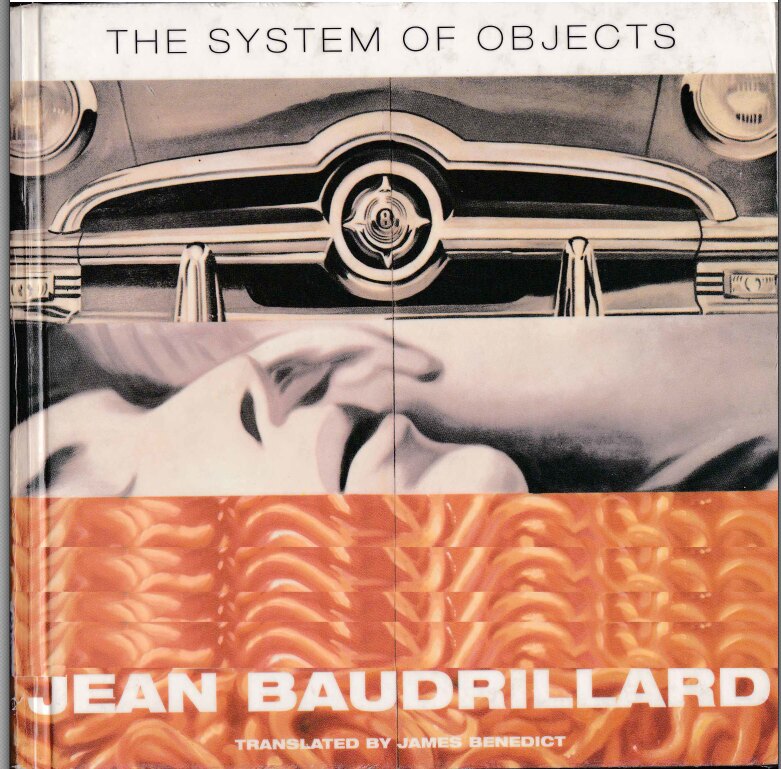
"The System of Objects": how the things we own define us
Jean Baudrillard, 1968 - reading notes
Why a 1968 book about furniture, gadgets and antiques explains the present better than almost anything else – and why it matters to me as a sculptor.
Have you ever wondered why we feel the need to change car every few years? Why an advertisement convinces us that a piece of furniture “suits us”? Why antiques fascinate us so much?
In his classic work The System of Objects (Le système des objets, 1968), the French sociologist and philosopher Jean Baudrillard gives an answer that offers no comfort at all: the objects of our everyday life are not tools. They are a structured system of significations – a language that speaks about us, about our desires, our fears and our unconscious drives.
The book sits at the root of my own practice. I work with weight – physical, linguistic and existential – and with objects that carry their load literally: a letter that becomes volume, a prayer rope that becomes painting, a kettlebell that becomes a vessel for cultural heritage. Baudrillard supplies the vocabulary for understanding exactly what happens when an object is detached from its use.
These are the seven ideas I keep from this reading.
The book as an audio summary
An audio summary of The System of Objects in conversational form, 27 minutes – a quick way into the book’s arguments. The voices are synthetic. It is not a reading of the text you have here, but a parallel route through the same themes.
1. Consumption as the dominion of the sign
Baudrillard’s most radical claim is that we never consume the object itself in its material substance, but its “difference” from other objects.
Consumption is not defined by the satisfaction of our needs; that is merely its precondition. It is defined as a systematic activity of manipulating signs. For an object to become an object of consumption it must first be turned into a “sign”: it must lose the direct, organic relation it once had with the human being and acquire meaning through its position within a wider, abstract system of other sign-objects.
This is why consumption has no limits. If we consumed in order to cover physical needs, at some point we would reach saturation. But because we consume signs and ideas, and because the process rests on a deeper existential lack – a void in human relations – desire remains unsatisfied and pushes us to want more and more.
It is precisely this conversion of the thing into a sign that is the ground of the series Sculpture of Language: letters that cease to carry meaning and become volume, space, construction. If the object is already language, then language can become object again.
2. From the traditional to the functional home
Baudrillard begins his analysis with the space of the home, showing how a change in furnishing reflects a change in family and social structures.
The traditional interior. The typical bourgeois house of the past was patriarchal, inward-looking and organised around heavy, immovable furniture – the sideboard, the bed at the centre of the room. These objects functioned as “household gods”, embodying emotional relations and the stability of the family. Time was measured by the pendulum of the clock, beating like a mechanical heart and offering security.
The modern “functional” interior. Today furniture has been freed from its moral and theatrical role. We have modular units, folding beds, low tables, open spaces in which everything communicates. Clocks and mirrors disappear from shared rooms. Modern people are no longer “owners” in the emotional sense, but “engineers of atmosphere” – managers who organise, control and regulate space as if it were a network of information.
3. From toil to control: how our gestures changed
In traditional societies the relation between people and their tools rested on muscular energy and bodily toil. That relation, painful as it was, had a deep symbolic and libidinal density: the gesture of reaping, ironing with a heavy iron.
In the modern technological world, physical effort has been replaced by a system of cerebral and sensory vigilance. All that is needed is a touch: buttons, levers, remote controls, photocells. This sterilised relation alienates us from our own technical power. As devices become more complex and autonomous, our own gestures grow poorer and we end up spectators of our own objects.
This is exactly where Weights of Art is placed. The kettlebell is one of the very few objects that refuse to remove toil – it exists in order to impose it. By turning its form into sculpture, the weight ceases to be an instrument of release and becomes a sign of reminder: the psychic load is transferred from inside the person to the external, material form of the object.
4. Antiques and the collection: the subjective escape
When the pure functionality of modern objects leaves us emotionally empty, we turn to two marginal systems for consolation.
Antiques as a myth of origin. Antiques have no practical usefulness; their role is exclusively to signify time. They work as an imaginary return to the womb, to the mother, or to the “Father” as a source of authenticity and prestige. In the case of restoring a farmhouse, we need a few “authentic” old stones or beams as talismans of “being”, in order to justify and purify the cold technology of our house.
The collection as a game with death. When we gather objects – from artworks to matchboxes – we remove them from their useful function in order to place them in a personal series. The object becomes “the finest of domestic animals”: utterly subjugated, it reflects only our own desired images and never looks back at us. Through the collection, the collector tries to control time and to exorcise the anxiety of death, recycling birth and absence within an entirely controlled, closed circuit.
This chapter concerns me directly. In Coexistence the prayer rope – object of prayer, memory and mourning – is decomposed and recomposed into 72 pieces: a collection that does not exorcise death but names it. The same holds for Pénthos, where collective mourning looks for matter to stand in.
5. Gadgets, robots and the illusion of automation
Modern industry produces an enormous quantity of gadgets – objects of excessive technical complexity but negligible usefulness, such as electric cocktail stirrers or devices that remove stones from fruit. They satisfy the myth of automation: the unconscious wish that “everything should work by itself”.
The ultimate object of this fantasy is the robot: a slave that resembles us morphologically but lacks the basic attribute of human sovereignty – sex. It represents a domesticated sexuality, drained of anxiety, functioning as a projection of our own narcissism.
The series Ostracism works precisely with the residue of this myth: broken screens, technological waste and fragments of concrete that become potsherds. When a fragment carries “Know thyself” written as a hashtag, the question is the same as Baudrillard’s: what remains of the subject once everything has become a sign?
6. Models, series and the trap of "personalisation"
In the socio-ideological field, Baudrillard introduces the fundamental distinction between the Model and the Series.
The Model belongs to the privileged minority and is characterised by quality, authenticity, durability and unique shades. The Series addresses the masses; serial objects are deliberately manufactured with reduced quality and lifespan – the famous planned obsolescence.
So that the consumer of the “series” may feel free and unique, industry offers the illusion of personalisation through minimal, inessential differences: choosing among 42 colours for the same car, or buying a waste bin decorated with flowers. This “freedom of choice” is a trap: it enrols us necessarily in the economic system, making us believe we are expressing our personality while in fact we are consuming mass-produced differences.
In 2013, in the social art project Hangers of the Public Space, I worked with exactly this residue: clothes and objects that had dropped out of the cycle of the series and re-entered public space as a gesture of solidarity – not as merchandise.
7. Credit and advertising: the colonisation of the future
The system of consumption is completed by two powerful instruments.
Credit. It overturns the traditional ethic of saving and effort. From now on, consumption precedes production: we enjoy the object before we have earned it, mortgaging our future. We are led into a form of modern “feudalism”, in which part of our future labour is already spoken for.
Advertising as maternal protection. Advertising does not simply persuade us to buy; it operates by the “logic of Father Christmas”. It offers psychological warmth and protection, creating the impression that a superior social entity cares for us and anticipates our desires. It invites us to join an imaginary collectivity in order to reduce the anxiety of our isolation.
The System of Objects today: a world of mirrors
The System of Objects remains startlingly current. It reveals that consumer society is not a paradise of freedom and abundance, but a sophisticated mechanism of social control and psychic incorporation.
Surrounded by sign-objects that promise to complete us, we end up living in a world of mirrors, communicating not with other people but with our own consumer fantasies.
Sculpture, for me, is an attempt to break that mirror. When you take an object out of the circuit of consumption and give it back its weight, you oblige it to stand before you as a thing – not as a sign. That is the thread running through all my work: to give things back the weight the system took from them.
Which object in your home do you feel “defines” you most?